











Landmark study finds plants create water-rich areas around roots
September 15, 2011
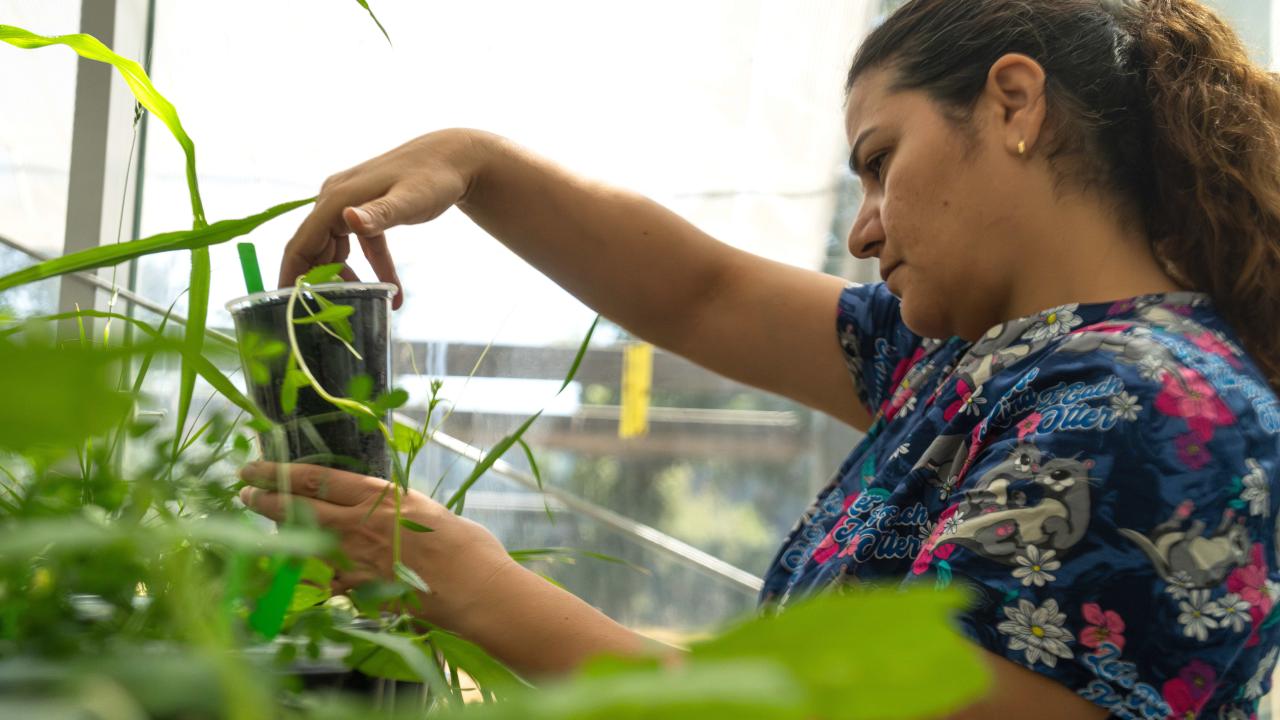
Ahmad Moradi in the Climate Chamber in the experimental hall at SINQ, the PSI Neutron Source. Plants are raised here under natural conditions before being investigated. (M. Fischer/PSI photo)
An international team of researchers led by a University of California, Davis, soil scientist has for the first time demonstrated that the soil around plant roots contains more water than does soil in other areas.
The findings, which contradict earlier beliefs that soil in the immediate vicinity of the roots has less water, could potentially lead to development of more drought-tolerant plants and more efficient irrigation systems.
The results of the study appear in the October issue of the scientific journal New Phytologist.
“Plants take water up from the ground by means of fine roots, a few millimeters in diameter,” said Ahmad Moradi, a postdoctoral fellow in the UC Davis Department of Land, Air and Water Resources. “Their thicker roots serve more as pipelines, to relay the water. We want to understand the water distribution around these fine roots because this is the place where the roots remove water from their surrounding soil.”
At the Paul Scherrer Institute in Switzerland, the researchers used a method known as neutron tomography to create a precise three-dimensional image of water distribution around the plant roots and in other soil areas. This technology allowed them to show the distribution of water to a fraction of a millimeter, without having to remove a plant from the soil.
“Neutrons are sensitive to water, and plant roots consist of around 90 percent water,” Moradi said. “When one wants to examine them, or the movement of water in the soil, neutrons are far better tools than X-rays.”
“It is probable that a gel-like substance that the roots exude is responsible,” said Andrea Carminati, a co-author at the University of Göttingen, Germany. “This substance can absorb 10,000 times its own dry weight of water. In this way, plants could create an emergency supply for short periods.”
In addition to Moradi and Carminati, the research team included Eberhard Lehmann of the Paul Scherrer Institute, Switzerland; Sascha Oswald of the University of Potsdam, Germany; and Hans-Jörg Vogel of the Helmholtz-Centre for Environmental Research, Germany.
Funding for the study was provided by the European Union Marie Curie Water Watch Project.
About UC Davis
For more than 100 years, UC Davis has engaged in teaching, research and public service that matter to California and transform the world. Located close to the state capital, UC Davis has more than 32,000 students, more than 2,500 faculty and more than 21,000 staff, an annual research budget that exceeds $684 million, a comprehensive health system and 13 specialized research centers. The university offers interdisciplinary graduate study and more than 100 undergraduate majors in four colleges — Agricultural and Environmental Sciences, Biological Sciences, Engineering, and Letters and Science. It also houses six professional schools — Education, Law, Management, Medicine, Veterinary Medicine and the Betty Irene Moore School of Nursing.
Media contact(s):
- Ahmad Moradi, Land, Air and Water Resources, (530) 752-1210, amoradi@ucdavis.edu
- Pat Bailey, UC Davis News Service, (530) 752-9843, pjbailey@ucdavis.edu
Return to the previous page