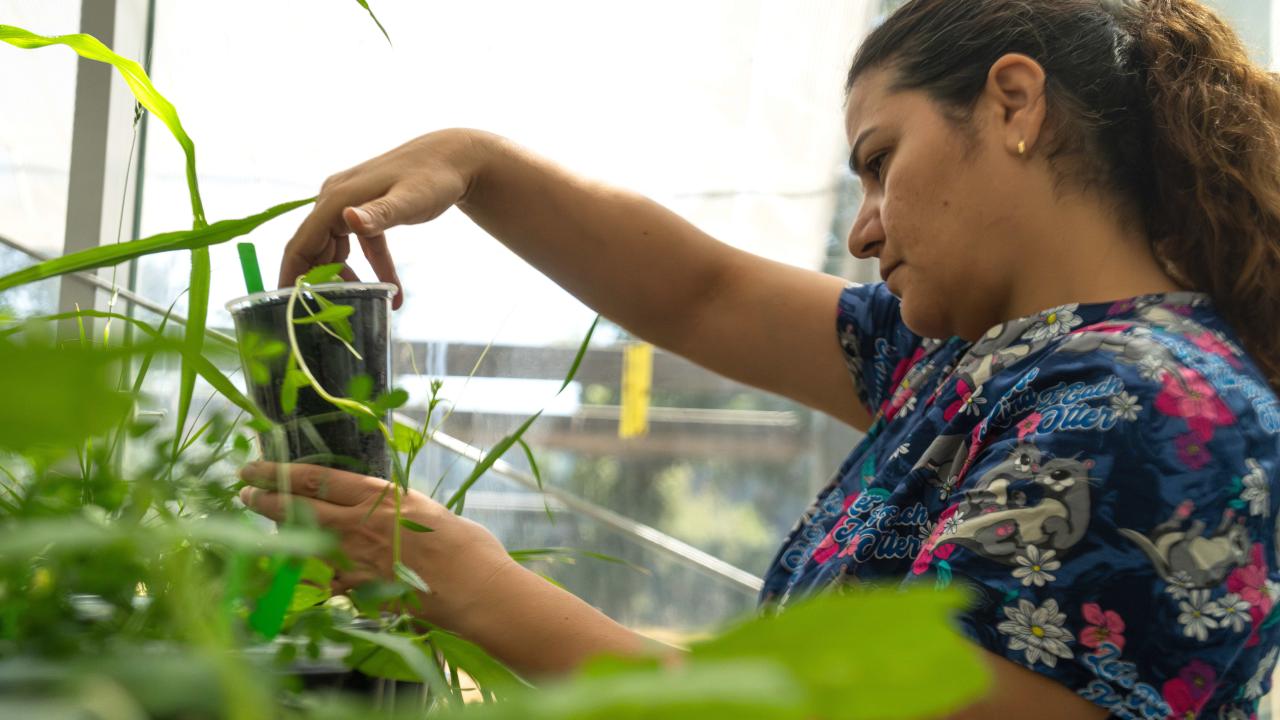












A genetically engineered tomato plant that thrives in salty irrigation
water and may hold the key to one of agriculture's greatest dilemmas has
been developed by plant biologists at the University of California, Davis,
and the University of Toronto.
As the first truly salt-tolerant crop, these tomatoes offer hope that
other crops can also be genetically modified for planting in many areas
of the world that have salty irrigation water and salt-damaged soils.
"Since environmental stress due to salinity is one of the most serious
factors limiting the productivity of crops, this innovation will have significant
implications for agriculture worldwide," said Eduardo Blumwald, who
led the research team that discovered the salt-tolerance gene. The research,
much of which was done at the University of Toronto, continues in the UC
Davis Department of Pomology.
The most recent findings by Blumwald and Hong-Xia Zhang, a postdoctoral
fellow at the University of Toronto, will be published July 31 in the August
issue of the journal Nature Biotechnology.
Worldwide an estimated 24.7 million acres (10 million hectares) -- about
one-fifth the area of California -- of once agriculturally productive land
are being lost annually because of irrigation-induced salinity, according
to the U.S. Department of Agriculture. Crop production is limited by salinity
on 40 percent of the world's irrigated land and on 25 percent of irrigated
land in the United States.
This progressive loss of farmable land is on a collision course with
the expanding global population, which over the next 30 years is expected
to require an increase in food production of 20 percent in developed countries
and 60 percent in developing nations.
Although scientists have been trying to develop salt-tolerant crop varieties
using selective breeding techniques throughout the past century, none of
those efforts has proven successful.
Crop irrigation is an age-old practice that allows farmers to be less
dependent on seasonal rainfall and the uncertainties of the weather. However,
irrigation also increases the salinity of soils and water by depositing
in the fields soluble salts such as sodium, calcium, magnesium, potassium,
sulfate and chloride that the water has picked up from the soils and rocks
it has passed through. Eventually these salts accumulate in the irrigated
soils at levels that decrease the vigor and productivity of the crops grown
there.
Salty irrigation water wreaks havoc on most plants by upsetting their
ability to take in water through their root cells. In fact, if salt concentrations
in the soil are very high, flow of water into the plant is actually reversed
and the plant dehydrates and dies as water is drawn out of its cells.
To counter this effect, Blumwald and Zhang genetically engineered tomato
plants that produce higher levels of a naturally occurring protein known
as a "transport protein." The gene that controls increased production
of the transport protein was taken from Arabidopsis, a relative of
the cabbage that is commonly used in plant research.
The transport protein uses energy available in the cells to move salt
-- in the form of sodium ions -- into compartments within the cells called
vacuoles. Once the salt is stashed inside the vacuoles it is isolated from
the rest of the cell and unable to interfere with the plant's normal biochemical
activity.
These genetically engineered salt-tolerant plants actually remove salt
from the soil. And because their salt-storing activity occurs only in the
plants' leaves, the quality of the tomato fruit is maintained.
Blumwald and colleagues have demonstrated that the genetically engineered
tomato plants grow and produce fruit even in irrigation water that is about
50 times saltier than normal. The plants were irrigated with water having
a salt concentration of 200 mM sodium chloride; this is more than one third
as salty as seawater, which is about 530 mM sodium chloride.
The tomato discovery is a continuation of Blumwald's research on salt
tolerance in plants. In 1999 he and colleagues announced that they had discovered
the gene that governs production of the transport protein and genetically
engineered salt tolerance in the Arabidopsis plant. They published
their findings in the Aug. 20, 1999, issue of the journal Science.
The transgenic tomato plants were grown in greenhouses at the University
of Toronto. Blumwald hopes to continue the research at UC Davis, including
field trials in salt-damaged soils. He projects that, with proper funding,
it would be possible to develop commercially useful salt-tolerant tomato
plants within three years.
Blumwald's transgenic salt-tolerance research was funded by the Natural
Sciences and Engineering Research Council of Canada and by the Will W. Lester
Endowment from the University of California.